Monday, May 12, 2008

Sunday Scribbling #110: Telephone

I've subscribed to Sunday Scribbling for months now but have never actually participated. The idea behind Sunday Scribbling (which must have originally been posted on Sunday) is "to provide inspiration and motivation for anyone who enjoys writing and would like a weekly challenge." Each week provides a different writing prompt. What comes from that prompt varies widely: poetry, essay, memory, flash fiction, slices of life, or just random thoughts.

Today's prompt: telephone.

********************************

To talk on the phone was all there was. In a notebook, the day’s tally: Lisa (llll lllll lll), Ros (lll), Robyn (llll llll llll llll), Janet (llll), Bryan (llll llll llll ll).

“The lake is windy” meant: “”I can’t say right now; my mother is in the room.”

You could only go as far as the cord would stretch. Your fingers play with the spiral of the cord, always your index finger tucked inside, until claustrophobia presses down too heavily. (Someday in the future there will be cordless phones, then cell phones.)

“Call me.”
“Call me.”
“Call me later.”

Later.
Lisa: colostomy, this summer.
Ros: 10 years or more, no word.
Robyn: turned into a swan
Janet: sending daughter off to college
Bryan: dead, 20 years, 7 months.

Weekly Geeks: Childhood Favorites


This is a repost of a Sunday Salon post, but it seems appropriate for this week's Weekly Geeks theme (my first): fond memories of childhood books

At 2:
Raggedy Ann and Andy and nursery rhymes


"Children are made readers on the laps of their parents."
— Emilie Buchwald


"You may have tangible wealth untold.
Caskets of jewels and coffers of gold.
Richer than I you can never be –
I had a mother who read to me."
— Strickland Gillilan


At 12:
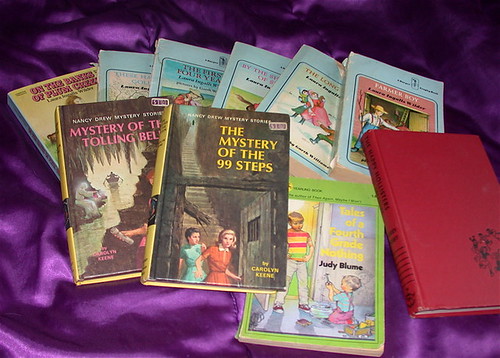
Nancy Drew, Laura Ingalls Wilder, Judy Blume, and the Happy Hollisters


She is too fond of books, and it has turned her brain. --Louisa May Alcott

A book reads the better which is our own, and has been so long known to us, that we know the topography of its blots, and dog's ears, and can trace the dirt in it to having read it at tea with buttered muffins. ~Charles Lamb, Last Essays of Elia, 1833

The stories of childhood leave an indelible impression, and their author always has a niche in the temple of memory from which the image is never cast out to be thrown on the rubbish heap of things that are outgrown and outlived. ~Howard Pyle


At 22:
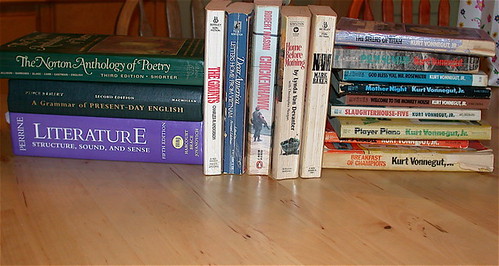
Vietnam, Vonnegut, and Vast Volumes of Literature and History (AKA, my senior year of college)


A good book should leave you... slightly exhausted at the end. You live several lives while reading it. ~William Styron

A book must be an ice-axe to break the seas frozen inside our soul. ~Franz Kafka


At 32:
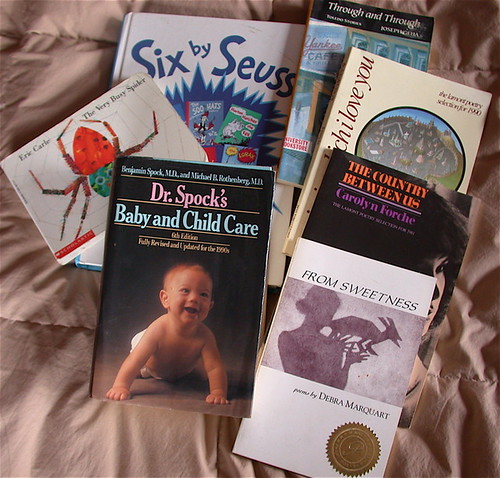
Motherhood and Graduate School


I would be most content if my children grew up to be the kind of people who think decorating consists mostly of building enough bookshelves. ~Anna Quindlen,

Far more seemly were it for thee to have thy study full of books, than thy purse full of money. ~John Lyly


At 42:
Books by Day for Them, Books by Night for Me


The love of learning, the sequestered nooks,
And all the sweet serenity of books.
~Henry Wadsworth Longfellow

Good friends, good books and a sleepy conscience: this is the ideal life. ~Mark Twain


Sunday, May 11, 2008

The Sunday Salon: Housewarming

This isn't my first Sunday Salon, but it is the first one here on SmallWorld Reads. I decided I needed a separate space for my reading life, as the books were crowding out my regular blog. In my real life—although I think about, read about, and talk about books a lot—I really only read in the evenings after the kids are in bed. (Well, except for all the reading I do with the kids.) So this is my after-hours, evening space now, devoted entirely to reading and writing. I am slowly working on transferring my book reviews over here, but that will likely take awhile.

In the meantime, I finished Susan's Breen's The Fiction Class this week. I was pleasantly surprised by this book that I pulled off the library shelf without a recommendation. Here is my review.

I'm taking full advantage of Mother's Day today. I've already read a few chapters of John Grisham's The Appeal and taken a nap. When I woke up from my nap, I thought about Li-Young Lee's book of poetry, Rose. I thought I remembered a poem he'd written about his mother. Of course I had to read the whole collection because you can't stop reading Li-Young Lee. The poem I was thinking about is called "Early in the Morning," in which Lee describes the ritual of his mother's hair pinning:

Early in the Morning

While the long grain is softening
in the water, gurgling
over a low stove flame, before
the salted Winter Vegetable is sliced
for breakfast, before the birds,
my mother glides an ivory comb
through her hair, heavy
and black as calligrapher's ink.

She sits at the foot of the bed.
My father watches, listens for
the music of comb
against hair.

My mother combs,
pulls her hair back
tight, rolls it
around two fingers, pins it
in a bun to the back of her head.
For half a hundred years she has done this.
My father likes to see it like this.
He says it is kempt.

But I know
it is because of the way
my mother's hair falls
when he pulls the pins out.
Easily, like the curtains
when they untie them in the evening.

-- Li-Young Lee, ©1986

I love this book, and while the relationship between Lee's mother and father does play prominently throughout, it is the memory of his father that graces nearly every poem, unifying the whole collection. I was first introduced to the poetry of Li-Young Lee in graduate school, and during my time in graduate school he did a reading at the university. I loved the way he read his poems, clearly, softly, lyrically, exactly like his written voice. His imagery is powerful, his language precise and beautiful. My favorite in Rose is called "From Blossoms." For me, growing up in orchards, this poem is the perfect expression of a joyful life:

From Blossoms

From blossoms comes
this brown paper bag of peaches
we bought from the boy
at the bend in the road where we turned toward
signs painted Peaches.

From laden boughs, from hands,
from sweet fellowship in the bins,
comes nectar at the roadside, succulent
peaches we devour, dusty skin and all,
comes the familiar dust of summer, dust we eat.

O, to take what we love inside,
to carry within us an orchard, to eat
not only the skin, but the shade,
not only the sugar, but the days, to hold
the fruit in our hands, adore it, then bite into
the round jubilance of peach.

There are days we live
as if death were nowhere
in the background; from joy
to joy to joy, from wing to wing,
from blossom to blossom to
impossible blossom, to sweet impossible blossom.

- Li-Young Lee ©1986

And so. I'm off for a short vacation to Colonial Williamsburg this week, which means a long car trip with Dr. H. driving, the kids watching DVDs, and me reading. I've got a good stack of books to bring with me: The Appeal (Grisham), Paula (Isabel Allende), Astrid and Veronika (Linda Olsson), Kitchen Confidential (Anthony Bourdain), Stop Dressing Your Six-Year-Old Like a Skank (Celia Rivenbark), Winter Wheat (M. Walker) and New Stories from the South: 2007. I'm so glad I don't get car sick!

Saturday, May 10, 2008

Book Review: The Fiction Class

This isn't something that happens to me very often: I was browsing the "new arrivals" shelves at the library a couple of weeks ago while the kids had a snack in the cafe, and I pulled out this book by Susan Breen. I almost stuck it back on the shelf, thinking about the stack of to-be-read books already by my bed, but I was intrigued.

And then I was so happy when I finished reading the mentally taxing Jayber Crow and started in with The Fiction Class. What an excellent book this turned out to be! The story centers on Arabella, a struggling writer who teaches an evening writing class to adults; the writing class itself; and on Arabella and her mother. Each chapter focuses on an aspect of writing: character, plot, theme, etc. and how this relates to Arabella, her class, and her mother. Breen's writing is concise and matter-of-fact, and I like that. The characters are well-rounded and somehow quite familiar, and I like that. Sometimes, being a small-town girl, I find it difficult to relate to novels that feature New York City-types; but Breen's characters could have been transported to anywhere and still made sense to me. (And here I need to clarify that, although I did indeed grow up in New York, I grew up in a small town upstate, which has little if no similarity to New York City except perhaps in the abundance of excellent pizza and wings.)

I loved that the actual writing assignments are included at the end of each chapter. For example, the writing assignment for point of view:

Think about a family gathering: a holiday, a birthday, a funeral. Write about that gathering in the first person from the point of view of a child.
I wished for chunks of time to do each assignment myself. Perhaps I will make that time soon. I did a little searching about the book because I wondered if somewhere in the blogosphere there might be a place where people are doing Breen's exercises on their blogs. I haven't found that yet, but I did find Susan Breen's blog and was inspired to see the tagline on her blog: "publishing a first novel after 25 years of marriage, 4 children, and hundreds of rejections." (Couldn't I at least turn out my poetry chapbook in the next 6 years?)

Turns out that Breen has a monthly contest at her website where she asks for submissions on a certain topic. For the April/May contest, she asks: Write a story using this as the first sentence: “Why are you wearing that?” The winner receives a free autographed copy of her book. Will I submit an entry to this or any future contests on Breen's website? Perhaps. And if a book can pull me out of my writing stupor and inspire me to actually write more than a daily blog, well. That says a lot.

But the books isn't just for writers or writing teachers. This is just a great book, and I hope to see more by Susan Breen.

Thursday, May 8, 2008

Book Review: Jayber Crow


Yes, I am celebrating: I finally finished reading Wendell Berry's Jayber Crow. I am pretty sure that I deserve something: a bag of caramels, some Marble Slab ice cream, or a check for $1000.

Honestly, I am stumped as to how to review this book. I mean, check out this introduction to the book on Amazon.com:
The questions who and what and how and why are no doubt useful and occasionally even noble in their place. But for Wendell Berry, whose spare and elegant prose has long testified to the rural American values of thrift and frugality, four interrogatives must seem a waste, when one will do. Where is the ultimate qualifier, the sine qua non, for both the author and his characters. Place shapes them and defines them; the winding Kentucky River and the gentle curves of the Kentucky hills find an echo in their lilting speech and brusque affections.
I don't even know what that means. First of all, I would not use the adjective "spare" to describe Wendell Berry's writing. Elegant, yes. Spare, no. Hemingway is spare. Faulkner is expansive. Berry lies closer to Faulkner on that scale. Berry's writing is carefully, beautifully, even majestically crafted; this is the ultimate poetic novel. One reviewer on amazon.com writes: "This book is about many things, but should be read mostly for the sake of experiencing Berry's really fine writing." I absolutely second that assessment. Berry offers profound insights and wisdom wrapped in exquisite language. Really, the character of Jayber Crow himself, former barber of the tiny Port William, is tertiary.

The story itself, on the basic plot level, is about the life of Jayber Crow and the rural town of Port William. But overriding this is the theme of what is lost with progress, and what is found in community. Living in an area that is forever being eaten by machinery, I know the ache of losing quiet beauty to big houses and faster ways of getting places. When you see the countryside bleeding red soil from its great gashes around here, you know how this is:
More than television, the interstate brought the modern world into Port William. More even than The Economy and The War, it carried the people of Port William into the modern world. It was a thing of unimaginable influence. People in Port William would find it handy to drive to work or to shop in Louisville. And Louisville would find it handy to grow farther out into the countryside. City lots would be carved out of farms, raising of course the price of farmland, so that urban people could enjoy the spaciousness of rural life while looking evening and morning at the rear ends of one another's automobiles.
And Berry surprised me with his insights into Christianity. I knew he advocated stewardship of the earth; I didn't know that he was tagged as a contemporary Christian writer. It was in the last half of this novel that Jayber Crow's spiritual journey becomes more pronounced, and I began folding down pages. Like Harper Lee in the magnificent To Kill a Mockingbird, Berry disposes of religious legalism and emphasizes the relational qualities taught by Christ: take care of one another. Love your neighbor. Breathe deeply.
On Sunday mornings I go up to ring the bell and sit through the service. I don't attend altogether for religious reasons. I feel more religious, in fact, here beside this corrupt and holy stream. I am not sectarian or evangelical. I don't want to argue with anybody about religious. I wouldn't want to argue about it even if I thought it was arguable, or even if I could win. I'm a literal reader of the Scriptures, and so I see the difficulties. And yet every Sunday morning I walk up here, over a cobble of quibbles. I am, I suppose a difficult man. I am, maybe, the ultimate Protestant, the man at the end of the Protestant road, for as I have read the Gospels over the years, the belief has grown in me that Christ did not come to found an organized religion but came instead to found an unorganized one. He seems to have come to carry religion out of the temples into the fields and sheep pastures, onto the roadsides and banks of rivers, into the houses of sinners and publicans, into the town and the wilderness, toward the membership of all that is here. Well, you can read and see what you think.
Brilliant. And the exquisite poetry: cobble of quibbles! Berry is remarkable, and yet I can't say I truly enjoyed this novel. My personal assessment is I need Berry in smaller does than a 360-page novel. I need to read Berry more as a poet and an essayist, and perhaps as a short story writer, before I tackle another of his novels. He's too enormous for this season of my life, in which my reading is limited to an hour in the evening, when I often can scarcely stay awake. He deserves a more careful audience.

Friday, May 2, 2008

Poetry for Children

“Whatever you do, find ways to read poetry. Eat it, drink it, enjoy it, and share it.”
~Eve Merriam


A commenter asked me a couple of weeks ago for suggestions for poetry to read to children. Before I list my favorite books written specifically for children, let me emphasize that you don't have to stick with "kids' poetry" when reading to your children. In other words, some poets write specifically for a younger audience--much of Jack Prelutsky, for example. But poetry doesn't have to rhyme and be about cute kitties or dog poop to appeal to children (although rhyming bodily functions certainly can heighten a child's appreciation of poetry).

Along those lines, I highly recommend A Treasury of Poetry for Young People. This contains poems selected with a younger audience (5th grade and up) in mind by some of the best-known poets: Carl Sandburg, Robert Frost, Emily Dickinson, Edgar Allen Poe, Walt Whitman and Henry Wadsworth Longfellow. There is a two or three page introduction of each author before his/her section of poetry. The illustrations are simple and beautiful. Notes at the bottom of each page give a very brief commentary on each poem. For example, at the end of the familiar Frost poem "The Road Not Taken," the note simply states: "We all know the feel of a cool autumn day, when we can shuffle our feet through fallen leaves and kick up the smells of the season. This is a poem about such a walk, about coming to a fork in the path, and about making choices in our lives."

For a wider variety of poets, I recommend the Poetry for Young People Series. These books are also published by Sterling Publishing, like the one above, but each books features a different poet. Scholastic often has these titles in their monthly sale fliers for home or school. Featured authors include: Robert Browning, Langston Hughes, Edna St. Vincent Millay, and all the ones mentioned above.

One more collection I really love for kids: The Oxford Illustrated Book of American Children's Poems, edited by Donald Hall. This one takes a chronological approach to American poetry, beginning with the Native American cradle song, "Chant to the Fire-Fly" and ending with the contemporary poetry of Sandra Cisneros and Janet S. Wong. I love the diversity offered in this collection: poetry isn't all written by white guys and reclusive women. And one of my personal favorites is included here: Nikki Giovanni's "Knoxville, Tennessee." Even if you don't live around these parts, you and your children can surely relate to Giovanni's ode to the pure bliss of summertime.

Of course, you can get out your old copy of The Norton Anthology of Poetry and just pick out age-appropriate poems from some of the world's best poets of all time. What? You don't have an old Norton's Anthology? Run to your nearest used bookstore or Goodwill and pick one up. Please. You never know when you might need to read T.S. Eliot's "The Love Song of J. Alfred Prufrock":
I grow old. . . . I grow old . . .
I shall wear the bottoms of my trouser rolled.
Shall I part my hair behind? Do I dare to eat a peach?
I shall wear white flannel trousers, and walk upon the beach.
I have heard the mermaids singing, each to each.
I do not think they will sing to me.
But I digress. Moving on to poetry written specifically for children, I must present my four favorites: Shel Silverstein, Jack Prelutsky, Eve Merriam, and Valerie Worth. Does anyone not know Shel Silverstein's works? Silverstein, who died in 1999, is the king of children's poetry. His website is great fun, and you can read all about his works there. You local library will have every book; better yet, buy at least a couple. No family library can possibly be complete with A Light in the Attic or Where the Sidewalk Ends. If your kids hear the word "poetry" and cover their ears, try reading "Sarah Cynthia Sylvia Stout Would Not Take the Garbage Out' to them. They will want to hear more.

Jack Prelutsky also has a gift for luring children in with the absurd. He knows how to engage children with the silly, absurd, and irresistibly disgusting:
Slime, slime,
Savory slime,
you're luscious and succulent
any old time,
there's hardly a thing
that is nearly as grand
as a dollop of slime
in the palm of my hand.

Prelutsky also has a great website, where you can read all about him and his books and get teaching ideas, too.

The poet Eve Merriam loved language--loved the sound of words alone and in combination with other words. When I read her poetry, I imagine how carefully she chose each word. From her widely anthologized "Lullaby":
Purple as a king's cape
Purple as a grape.

Purple for the evening
When daylight is leaving.

Soft and purry,

Gentle and furry,

Velvet evening-time.
I have a cassette tape of Merriam reading some of her poetry; when my oldest was little, this was one of his favorites. Check out your local library or amazon.com for poetry by Eve Merriam, including You Be Good and I'll Be Night and A Sky Full of Poems.

VOne last poet who might be less familiar but who also takes great care in crafting poetry: Valerie Worth. In the wonderful All the Small Poems and Fourteen More, Worth turns every day things--animal, vegetable and mineral--into exquisite works of art. This is a fantastic collection for teaching personification, metaphor and simile, and for emphasizing the power of observation and the craft of language.
The sun
is a leaping fire
too hot
to go near,
But it will still
lie down
in warm yellow squares
on the floor
lie a flat
quilt, where
the cat can curl
and purr.

This is just a tiny taste of the wonderful feast that is the world of poetry. Surf the internet and shuffle through the library bookshelves. If you had a bad experience with poetry in your own schooling, try again--with your child. I promise, you'll both find something you love.

Thursday, May 1, 2008

Three by Barefoot Books


Barefoot Books is a relatively new publisher, started in 1993 by moms Nancy Traversy and Tessa Strickland. They describe their story and vision:
When you start out, no one has heard of you, and you wonder if anyone is going to listen to what you have to say. No one was publishing books quite like ours—would anyone buy them? We believed they would; we just had to find our way to parents and educators who shared our values. This is what we care about: first, we're convinced that it's never too early to introduce children to other cultures. We believe too that children can appreciate high-quality art, and enjoy the music as well as the meaning of language from a very early age.

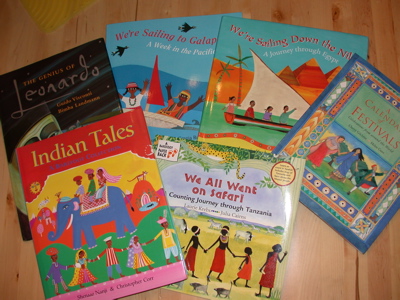
I love books that feature different cultures, and Barefoot Books does this well. My first-grader loves three "travel" books: We're Sailing to Galapagos, We All Went on Safari, and We're Sailing Down the Nile. First of all, the books are gorgeous. The illustrations are bright and colorful without being too chaotic and cluttered. Each book gives geographical and cultural details in fun, sing-song verses.

We're Sailing to Galapagos: A Week in the Pacific, is our favorite. The rhyming text introduced the wildlife of the Galapagos Islands, from albatrosses to lava crabs. Duncan loves the repeated chorus:
"We're sailing to Galapagos, Galapagos, Galapagos,
We're sailing to Galapagos. I wonder who we'll see."

This book made me want to do a unit study on the Galapagos! The last several pages of the book give more detail about the Islands and its animal inhabitants.

We All Went on Safari: A Counting Journey Through Tanzania, is beautiful counting/language/ culture/wildlife book. A group of Maasai people journey over Tanzanian grasslands and past acacia trees, counting various African animals--in both English and Swahili. Like the Galapagos book, this one devotes several pages at the end to information about the Maasai people, the Swahili language, and facts about Tanzania. This would be a great supplement to any study of African countries.

We're Sailing Down the Nile: A Journey Through Egypt is the least engaging of the three for us. Somehow the rhythm doesn't flow as well as the other two, and the illustrations weren't as engaging. I guess also, there is so much great material out there already about Egypt but not much about Tanzania and the Galapagos, so the first two books really stood out for me.

I think Barefoot Books will be a solid contender in the children's book market. The books are reminiscent of Usborne Books but with more of a cultural rather than historical focus--and the illustrations are more vibrant. I see on their site that, like Usborne, one can run a home-based business by selling Barefoot Books. I used to sell Usborne in this way and accumulated a wonderful library; if my children were younger, I'd consider selling Barefoot! They also have an affiliate program like Amazon.