Thursday, May 1, 2008

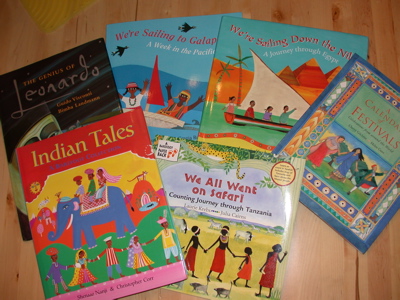
Three by Barefoot Books


Barefoot Books is a relatively new publisher, started in 1993 by moms Nancy Traversy and Tessa Strickland. They describe their story and vision:
When you start out, no one has heard of you, and you wonder if anyone is going to listen to what you have to say. No one was publishing books quite like ours—would anyone buy them? We believed they would; we just had to find our way to parents and educators who shared our values. This is what we care about: first, we're convinced that it's never too early to introduce children to other cultures. We believe too that children can appreciate high-quality art, and enjoy the music as well as the meaning of language from a very early age.

I love books that feature different cultures, and Barefoot Books does this well. My first-grader loves three "travel" books: We're Sailing to Galapagos, We All Went on Safari, and We're Sailing Down the Nile. First of all, the books are gorgeous. The illustrations are bright and colorful without being too chaotic and cluttered. Each book gives geographical and cultural details in fun, sing-song verses.

We're Sailing to Galapagos: A Week in the Pacific, is our favorite. The rhyming text introduced the wildlife of the Galapagos Islands, from albatrosses to lava crabs. Duncan loves the repeated chorus:
"We're sailing to Galapagos, Galapagos, Galapagos,
We're sailing to Galapagos. I wonder who we'll see."

This book made me want to do a unit study on the Galapagos! The last several pages of the book give more detail about the Islands and its animal inhabitants.

We All Went on Safari: A Counting Journey Through Tanzania, is beautiful counting/language/ culture/wildlife book. A group of Maasai people journey over Tanzanian grasslands and past acacia trees, counting various African animals--in both English and Swahili. Like the Galapagos book, this one devotes several pages at the end to information about the Maasai people, the Swahili language, and facts about Tanzania. This would be a great supplement to any study of African countries.

We're Sailing Down the Nile: A Journey Through Egypt is the least engaging of the three for us. Somehow the rhythm doesn't flow as well as the other two, and the illustrations weren't as engaging. I guess also, there is so much great material out there already about Egypt but not much about Tanzania and the Galapagos, so the first two books really stood out for me.

I think Barefoot Books will be a solid contender in the children's book market. The books are reminiscent of Usborne Books but with more of a cultural rather than historical focus--and the illustrations are more vibrant. I see on their site that, like Usborne, one can run a home-based business by selling Barefoot Books. I used to sell Usborne in this way and accumulated a wonderful library; if my children were younger, I'd consider selling Barefoot! They also have an affiliate program like Amazon.


Sunday, April 27, 2008

The Never-ending Memoir of Jayber Crow

April 27, 2008


The Sunday Salon.com

Yes, I am still reading Wendell Berry's Jayber Crow. I am quite certain that this is my third week in the mind of Jayber Crow, and I am barely halfway through. I know I am not giving Berry the careful reading he deserves. He is obviously a superb writer. He is my favorite kind of writer: poetic and lyrical, with a careful ear for language. Nearly every page has a liberal dose of breathtaking wisdom. But I'm just so sleepy at night when I finally have a chance to begin reading, and I'm afraid Berry's simple profundity is overtaxing my weary brain. It's been one of those months.

I did manage to review a couple of children's books this week: three titles by Barefoot Books and a picture book called Boston Tea Party.

Tomorrow is my last American Literature class at our co-op. We'll finish discussing John Knowles' A Separate Peace, which I've been re-reading over the past two weeks. I've thoroughly enjoyed teaching this class and revisiting these eight classic novels (as well as poetry, short story, and drama) has been wonderful. Some I hadn't read myself since college, and reading with teaching in mind adds another whole dimension to the experience. In spite of how much I've loved teaching the class, I am tremendously glad that it'll be over after tomorrow! Now I can return to my regularly scheduled voracious reading.

Last week I posted the most recent books added to my TBR list. This week I'll post the ones that have been on my list the longest--the first page of the list. But first, here are the books I've added this week. I'm trying to get better about recording where I originally saw the book reviewed; my apologies to those I forget to record:

Confessions of a Common Reader by Anne Fadiman (reviewed by Literary Feline)
Three Cups of Tea by G. Mortenson
Trauma and Ghost Town by P. McGrath
Papua New Guinea: Notes from a Spinning Planet by M. Carlson (reviewed by Clean Reads)

And back to the beginning of the TBR list. Some of these have been on here so long, I have no idea why I added them in the first place. If you have something to say about any of them, please do! Perhaps it'll renew my interest in some of them, as I tend to gravitate more toward more recent additions to the TBR list:

Aprons on a Clothesline by T. DePree
Mater Biscuit by J. Cannon
Queen of the Big Time by A. Trigiani
Winter Seeking by V. Wright
Minding the South by J. Reed
Sweet Potato Queen by J. Browne
Mad Girls in Love by M. West
Little Altars Everywhere by R. Wells
Living End by L. Samson
All Good Gifts by K. Morgan
Last Storyteller by D. Noble
The Departed by K. Mackel
Other Voices, Other Rooms by Truman Capote
Breakfast at Tiffany's by Capote
Summerland by M. Cabon
Short Guide to a Happy Life by A. Quindlen
Mariner's Compass by E. Fowler
God Is the Gospel by J. Piper
Heaven by R. Alcorn
Family Nobody Wanted by Doss
Other Side of the Bridge by Mary Lawson
Confederate in the Attic
Stop Dressing Your Six-Year-Old Like a Skank by Celia Rivenbark

Thus ends page one.

Post A Comment!.....


Comments

Monday, April 28, 2008 - Great List

Posted by Anonymous (72.85.3.234)

Thanks for posting on Berry. I love his writing as well, but like you, sometimes I get bogged down in him.

Thanks, too, for the list of reads and for the comment on my blog.
Andi Lit

Permanent Link Edit Delete

Monday, April 28, 2008 - Aprons on a Clothesline

Posted by Anonymous (69.129.110.34)

I loved this series. I read it a while ago-- before I had a blog or was writing reviews but I really enjoyed it. I recall that I liked Aprons even better than the first two.(I think) ;)

Amy
http://readingtoolate.net

Permanent Link Edit Delete

Wednesday, April 30, 2008 - Untitled Comment

Posted by Anonymous (72.160.107.63)

Hey,

Could you suggest some good books to read to a 4 or 5 year old? I must have read a 1000 or 2000 books, and I'm running out of ideas. I'm also getting tired of just pulling a bunch off the library shelf and hoping some of them are good. Maybe some good, but basic, little chapter books?

Christina from Oregon

Permanent Link Edit Delete

Wednesday, April 30, 2008 - Untitled Comment

Posted by SmallWorld (24.151.178.103)

Christina:
I would LOVE to suggest books for kids! Give me a day or so and I'll have a post!

Permanent Link Edit Delete

Wednesday, April 30, 2008 - Untitled Comment

Posted by JenIG (67.72.98.46)

ok, that last title just made me laugh. but i have to sadly admit... a book like that is needed nowadays

Permanent Link Edit Delete

Saturday, May 3, 2008 - Untitled Comment

Posted by Margaret (68.42.29.163)

You asked for comments on the books on your list. I read Little Altars Everywhere years ago and thought it was a terrible book. All the worst aspects of contemporary fiction: bleak with no redeeming value. As I said it was a long time ago, but I still remember hating it. Check out some of the 1-star reviews on Amazon. I know that's not always the best gauge of quality, but...

Permanent Link Edit Delete

Saturday, May 3, 2008 - Untitled Comment

Posted by SmallWorld (24.151.178.103)

Margaret: thanks--I'll cross that one off my list!

Friday, April 25, 2008

Boston Tea Party


Here in our own small world, we have been immersed in the Revolutionary War era for several weeks now. This fabulous picture book written by Pamela Duncan Edwards and illustrated by Henry Cole really ties it all together in a way that was perfect for both my 1st and 5th graders. The story is actually told in imitation of the nursery rhyme "This is the house that Jack built," which sounds really silly, but it was incredibly effective. The narrative opens with "These are the leaves that grew on a bush in a far off land and became part of the Boston Tea Party" and builds from there, to ultimately lead to "These are Americans, independent and free..." In between the story of the prelude to the Revolutionary War is told. At the bottom of each page, a chorus of mice spout off more details about this time period. Sounds weird, I know, but those are smart little mice. And the illustrations are absolutely gorgeous. This is a book that needs to start being on all of the lists of "recommended reading for the Revolutionary War."

Saturday, April 19, 2008

To Kill a Mockingbird

I've been putting off this review for a couple of weeks now. How can I possibly express the utter perfection of this novel? I first read Harper Lee's phenomenal debut when I was in high school. I fell madly in love with it and read it again. Read it again in college, again in my 20s and in my 30s. It is the only book I have read more than twice (other than the Bible) since I was a child. I have always maintained that it is my favorite book, and after reading it again in my 40s, I wish that a spot existed higher than #1.

Why do I love this novel so much? I think because everything that matters is here. Jesus said that that the two greatest commandments are to "Love the Lord your God with all your heart, all your soul, all your mind, and all your strength" and to "Love your neighbor as yourself." And in this novel, Harper Lee puts these beautiful words into action through her characters. Take, for example, these quotes:

Love Your Neighbor as Yourself:
I think there's just one kind of folks. Folks. ~Scout
You never really understand a person until you consider things from his point of view... Until you climb inside of his skin and walk around in it. ~Atticus

Don't matter who they are, anybody sets foot in this house, they are company and don't let me catch you remarking on their ways like you were so high and mighty. ~ Calpurnia

Folks don’t like to have somebody around knowing more than they do. It aggravates them. You’re not going to change any of them by talking right, they’ve got to want to learn themselves, and when they don’t want to learn there’s nothing you can do but keep your mouth shut or talk their language. ~Calpurnia
On Religion vs. Following Christ
We're so rarely called on to be Christians, but when we are, we've got men like Atticus to go for us. ~Miss Maudie.

If spitting in my face and threatening me saved Mayella Ewell one extra beating, that's something I'll gladly take. ~Atticus

Mockingbirds don't do one thing but make music for us to enjoy. They don't eat up people's gardens, don't nest in corncribs, they don't do one thing but sing their hearts our for us. That's why it's a sin to kill a mockingbird. ~Miss Maudie

Footwashers believe anything that's pleasure is a sin. Did you know some of 'em came out of the woods one Saturday and passed by this place and told me me and my flowers were going to hell? … They thought I spent too much time in God's outdoors and not enough time inside the house reading the Bible. ~Miss Maudie

Sometimes the Bible in the hand of one man is worse than a whiskey bottle in the hand of--oh, your father. ... If Atticus Finch drank until he was drunk he wouldn't be as hard as some men are at their best. there are just some kind of men who--wh're so busy worrying about the next world they've never learned to live in this one, and you can look down the street and see the results. ~Miss Maudie

On Equality and Justice:
The one place where a man ought to get a square deal is in a courtroom, be he any color of the rainbow, but people have a way of carrying their resentments right into a jury box. As you grow older, you'll see white men cheat black men every day of your life, but let me tell you something and don't you forget it - whenever a white man does that to a black man, no matter who he is, how rich he is, or how fine a family he comes from, that white man is trash. ~Atticus
If there's just one kind of folks, why can't they get along with each other? If they're all alike, why do they go out of their way to despise each other? ~Jem

How can you hate Hitler so bad an' then turn around and be ugly about folks right at home? ~Scout
On Courage:
I wanted you to see what real courage is, instead of getting the idea that courage is a man with a gun in his hand. It's when you know you're licked before you begin but you begin anyway and you see it through no matter what. You rarely win, but sometimes you do. ~Atticus
It was times like these when I thought my father, who hated guns and had never been to any wars, was the bravest man who ever lived. ~Scout
It's when you know you're licked before you begin but you begin anyway and you see it through no matter what. ~Atticus
On Integrity:
They're certainly entitled to think that, and they're entitled to full respect for their opinions... but before I can live with other folks I've got to live with myself. The one thing that doesn't abide by majority rule is a person's conscience. ~Atticus
Atticus Finch is the same in his house as he is on the public streets.~ Miss Maudie
On Growing Up:
The sixth grade seemed to please him from the beginning: he went through a brief Egyptian Period that baffled me - he tried to walk flat a great deal, sticking one arm in front of him and one in back of him, putting one foot behind the other. He declared Egyptians walked that way; I said if they did I didn't see how they got anything done, but Jem said they accomplished more than the Americans ever did, they invented toilet paper and perpetual embalming, and asked where would we be today if they hadn't? Atticus told me to delete the adjectives and I'd have the facts. ~Scout
There was no doubt about it, I must soon enter this world, where on its surface fragrant ladies rocked slowly, fanned gently, and drank cool water. ~Scout
Atticus said that Jem was trying hard to forget something, but what he was really doing was storing it away for a while until enough time passed. Then he would be able to think about it and sort things out. When he was able to think about it, Jem would be himself again. ~Scout
On Parenting:
When a child asks you something, answer him, for goodness' sake. But don't make a production of it. Children are children, but they can spot an evasion quicker than adults, and evasion simply muddles 'em. ~Atticus
Bad language is a stage all children go through, and it dies with time when they learn they're not attracting attention with it. ~Atticus
Before Jem looks at anyone else he looks at me, and I've tried to live so I can look squarely back at him. ~ Atticus

There's a lot of ugly things in this world, son. I wish I could keep 'em all away from you. That's never possible. ~Atticus
On Education:
Miss Caroline caught me writing and told me to tell my father to stop teaching me. "Besides," she said, "we don't write in the first grade, we print. You won't learn to write until you're in the third grade." ~Scout

The remainder of my school days were no more auspicious than the first. Indeed, they were an endless Project that slowly evolved into a Unit, in which miles of construction paper and wax crayon were expended by the State of Alabama in its well-meaning but fruitless efforts to teach me Group Dynamics. What Jem called the Dewey Decimal System was school-wide by the end of my first year, so I had no chance to compare it with other teaching techniques. I could only look around me: Atticus and my uncle, who went to school at home, knew everything-at least, what one didn't know the other did. Furthermore, I couldn't help noticing that my father had served for years in the state legislature, elected each time without opposition, innocent of the adjustments my teachers thought essential to the development of Good Citizenship. Jem, educated on a half-Decimal half - Duncecap basis, seemed to function effectively alone or in a group, but Jem was a poor example: no tutorial system devised by man could have stopped him from getting at books. As for me, I knew nothing except what I gathered from Time magazine and reading everything I could lay hands on at home, but as I inched sluggishly along the treadmill of the Maycomb County school system, I could not help receiving the impression that I was being cheated out of something. Out of what I knew not, yet I did not believe that twelve years of unrelieved boredom was exactly what the state had in mind for me. ~ Scout

The second grade was grim, but Jem assured me that the older I got the better school would be, that he started off the same way, and it was not until one reached sixth grade that one learned anything of value. ~Scout


I could go on and on. If you haven't read the book, please read it, and then read it again. I get more out of it upon every reading. I can understand why Harper Lee never wrote another novel. Some say she must have a world of writing stored inside of her, but it seems to me just pretty much covered everything already.


Friday, April 18, 2008

We Wish to Inform You That Tomorrow We Will be Killed With Our Families: Stories from Rwanda

I presume you are reading this book because you desire a closer look, and that you, too, are properly disturbed by your curiosity. Perhaps, in examining this extremity with me, you hope for some understanding, some insight, some flicker of self-knowledge--a moral, or a lesson, or a clue about how to behave in this world: some such information. I don't discount the possibility, but when it comes to genocide, you already know right from wrong. The best reason I have come up with for looking closely into Rwanda's stories is that ignoring them makes me even more uncomfortable about existence and my place in it.
I struggled to read this book by Philip Gourevitch for two entire weeks. Like Gourevitch says, there is a moral obligation to know about what went on in Rwanda. What was I doing when 800,000 human beings were murdered by their neighbors? I was enjoying my first child, who had just turned one. I spent my days pushing a baby in a blue stroller on clean sidewalks in a college town in Ohio. If I heard of "Rwanda" at all, it was while I cut up bananas and placed them on my baby's high-chair while the evening news played in the background.
The piled-up dead of political violence are a generic staple of our information diet these days, and according to the generic report all massacres are created equal: the dead are innocent, the killers monstrous, the surrounding politics insane or nonexistent. Except for the names and the landscape, it reads like the same story from anywhere in the world: a tribe in power slaughters a disempowered tribe, another cycle in those ancient hatreds, the more things change the more they stay the same. ... The generic massacre story speaks of "endemic" or "epidemic" violence and of places where people kill "each other." and the ubiquity of the blight seems to cancel out any appeal to think about the single instance. These stories flash up from the void and, just as abruptly, return there. The anonymous dead and their anonymous killers become their own context. The horror becomes absurd.
Here is a story, then, of what went on in Rwanda in 1994 when the government of Rwanda called everyone in the Hutu majority to kill everyone in the Tutsi minority. In a period of three months, genocide swept through the country. Hutu uncles murdered their Tutsi nephews. Neighbors who once dined together took up machetes and murdered.

It is all, still, impossible to grasp. I'm not crazy about Gourevitch's writing style, but it doesn't really matter. Read this book, or any book about the Rwandan genocide, because we don't know anywhere near enough.

Knitting Circle

This book by Ann Hood was the perfect book to read on the heels of Stories from Rwanda. This story is a nice blend of familiar and predictable, with a few stereotypical characters sprinkled in, mixed with likeable characters and some good moments. Forty-something Mary Baxter has just lost her 5-year-old daughter and in desperation takes to knitting, which she has been assured will be strangely comforting. (Apparently this story is semi-autobiographical, as Hood lost her own 5-year-old daughter to a rare form of strep.) Eventually Mary joins a knitting circle and meets other women with tragic tales: cancer, assault, divorce, loss. Ultimately Mary and the others work through their grief by telling their stories and form a strong bond of friendship. It’s a story that’s been told a thousand times in as many different ways, but Hood is a good writer with strong, interesting characters.

Curious Incident of the Dog in the Night-Time

This will not be a funny book. I cannot tell jokes because I do not understand them. Here is a joke, as an example. It is one of Father's: His face was drawn but the curtains were real. I know why this is meant to be funny. I asked. It is because drawn has three meanings. ... If I try to say the joke to myself, making the word mean three different things at the same time, it is like hearing three different pieces of music at the same time, which is uncomfortable and confusing and not nice like white noise. It is like three people trying to talk to you at the same time about different things. And that is why there are no jokes in this book.
The narrator of this book by Mark Haddon is a 15-year-old autistic boy. Late one night Christopher discovers that his neighbor's dog has been killed by a garden tool, and he sets out to find the murderer. In the course of his investigation, he must step outside his comfort zone over and over again, and he discovers all kinds of frightening and confusing information. Christopher is also a mathematical genius, and he works through his world by processing events in a logical, mathematical way--as much as he can.

I stayed up way too late for two nights reading this book. It was absolutely fantastic. The author is never sentimental about Christopher. He leads us into Christopher's world immediately, without commentary. it really is Christopher's book--not a book about Christopher. Thanks to Kristina for suggesting this book. I'd absolutely pass on the recommendation.